

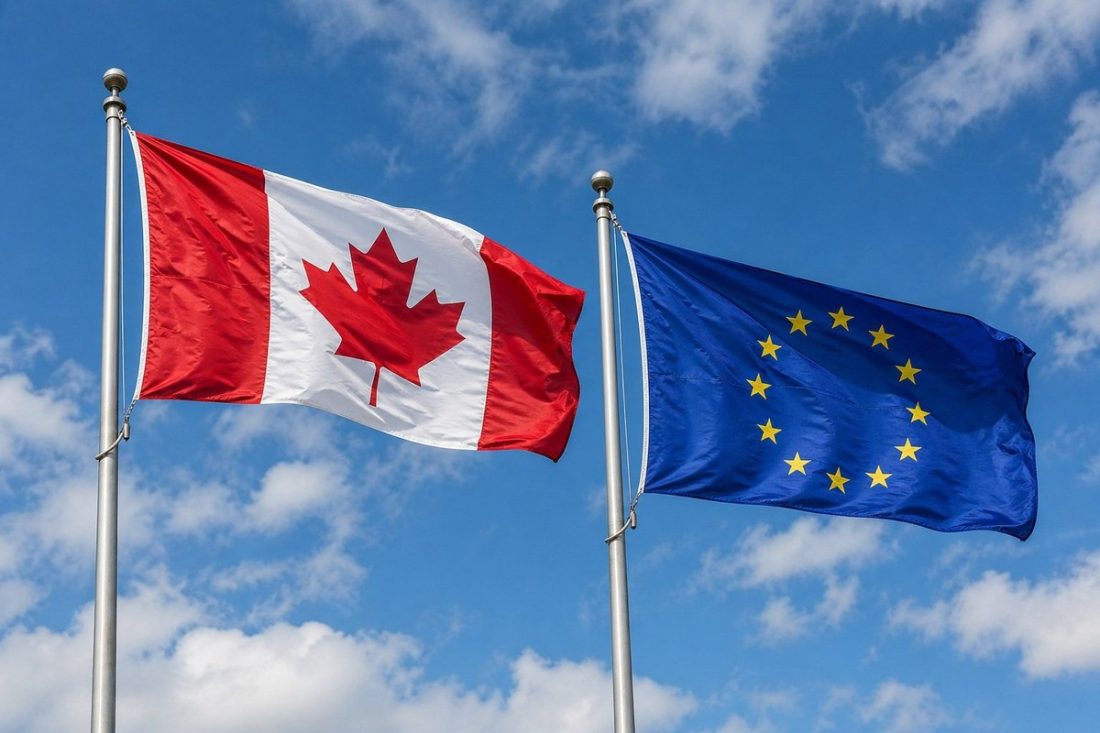
Canada, “Associate Member” of the EU: a Label in Search of a Sense
Ursula von der Leyen’s recent State of the Union address produced one line that travelled further than the rest of the speech combined. Turning to Mark Carney, seated in the Strasbourg hemicycle, she said she wanted to work with him on opening the door for Canada to become the first “associate member” of the European Union. The Canadian prime minister crossed the floor and embraced her, the Parliament rose, and within a day Australia and New Zealand were being mentioned as the next in line. Within two, Washington was talking about higher tariffs.
Lawyers will point out, correctly, that no such status exists in the Treaties. That is true and, for the purposes of this blog, the less interesting objection. The more useful question is economic: what, concretely, would an “associate member” get that a well-drafted association agreement, or for that matter a fully ratified CETA, would not? And who inside the European Union would pay for it?
Start from what already exists
The EU and Canada are not strangers looking for a first date. CETA has been provisionally applied since 2017 and, according to the Commission’s own figures, bilateral trade has grown by about 75 per cent in less than a decade. What has not happened yet is ratification: ten EU member states, including France, Italy and Poland, have still not completed the process. This is the first economic fact worth holding on to. The Union is offering Canada a new, higher tier of integration while it has not managed to finish the lower one. Any serious estimate of the marginal gain from “associate membership” has to start by netting out what CETA already delivers on tariffs, and what it would deliver on investment protection and services if the missing ratifications ever arrived.
Once tariffs are largely gone, the remaining barriers to transatlantic trade are regulatory: conformity assessment, standards, professional qualifications, procurement thresholds, data flows. This is the terrain on which the single market was built, and it is precisely the terrain that a status short of membership cannot easily reach. The EEA states obtained access to it by accepting the acquis dynamically and without a vote, plus free movement of persons. The reporting from Brussels suggests that the Canadian version would offer no residence rights, at least initially, and would instead create a new category of partners for enhanced trade and cooperation on defence, AI and high-tech research. That is a description of CETA-plus with a security chapter. It is a perfectly respectable thing to negotiate. It is not an economic transformation, and calling it “membership” does not change the arithmetic.
Gravity does not read speeches
The second fact is geography. Roughly three-quarters of Canadian exports go to the United States, for reasons that have nothing to do with politics and everything to do with distance, integrated supply chains and a shared language of regulation. Trade models are unromantic about this. Even a deep agreement with the EU would shift Canada’s trade composition at the margin, not at the core, unless the US relationship collapses to a degree that no one in Ottawa actually wants. The Canadian ambassador-designate to the EU has said as much, in more diplomatic terms: Ottawa cares about outcomes, not labels, and prefers the language of a “unique alliance”. That is a government hedging against a headline it did not write.
The EU’s own motives are more transparent. The Union wants critical minerals it does not have, LNG it stopped buying from Russia, and a second pillar for a defence industrial base it is trying to build under a “buy European” logic that a Canadian partner would help to soften without opening the door to American primes. Each of these is a legitimate strategic objective. None of them requires a constitutional novelty. They require procurement rules, a subsidy-control chapter and, for minerals, long-term offtake arrangements, which is to say the ordinary tools of trade policy.
The competition angle
This is where the blog’s usual concerns come in. Deeper market access without membership raises, sooner or later, the level playing field problem that dominated the Brexit negotiations. If Canadian firms are to bid for European defence money, participate in EU research programmes and sell into a market shielded by the Foreign Subsidies Regulation, the Union will ask what discipline applies to Canadian state support. Canada has no State aid regime in the European sense; its provinces subsidize freely and its federal government has become an enthusiastic practitioner of industrial policy in batteries and semiconductors. The UK Trade and Cooperation Agreement solved this with a bespoke subsidy-control chapter and a domestic authority. Something similar would be the price of admission for Canada, and it is a price that touches provincial competences, which is where Canadian treaty-making has historically stalled.
The mirror image applies to merger control and antitrust. An “associate member” would presumably not be subject to the Commission’s jurisdiction under Regulation 139/2004 any more than Norway is; the EEA solved this with a surveillance authority and a court, a machinery no one is proposing to replicate for Ottawa. Without it, the practical content of “association” in the competition field is what already exists: a cooperation agreement on enforcement, mutual notifications and the occasional coordinated dawn raid. Useful, but decades old.
Who gains inside the Union
The third fact is distributional, and it is the one least discussed. The benefits of a closer Canadian relationship concentrate where the trade already is: Germany, the Netherlands, France, Belgium, Italy. Peripheral economies, Romania among them, trade little with Canada and would gain mostly through second-round effects. Meanwhile, the political capital spent on inventing a new tier of association is capital not spent on the accession files that actually matter to the eastern member states, Ukraine and Moldova first among them. It is no accident that the “associate member” formula was originally floated by Chancellor Merz for Ukraine, as a substitute for an accession that Berlin does not expect to complete soon. Transplanted to Canada, the same formula risks turning into a three-tier Union, in which the second tier is reserved for rich, distant democracies and the third for poor, adjacent ones. That is a strange signal to send from Strasbourg in an enlargement year.
What would be worth doing
None of this argues against a deeper EU–Canada relationship. It argues for doing it in the one form that works: complete the ratification of CETA, add a security and defence protocol, negotiate sectoral regulatory alignment where the economics justify it (procurement, digital, minerals, possibly professional services), and attach a subsidy-control chapter with teeth. All of this fits within Article 217 TFEU and requires no new vocabulary. If the Union then wants to give Canada a seat at the table in the sense Merz envisaged for Kyiv, it should say so openly and open the Treaties, with all that implies for Turkey, the United Kingdom and the Western Balkans.
What it should not do is what it has just done: announce a status that does not exist, cannot be delivered without unanimity and treaties changes and adds no measurable economic content beyond what a completed CETA would provide, while handing a hostile White House the pretext for a new round of tariffs on European exporters. In Romania we have a phrase for institutions that adopt the form of something without its substance: formă fără fond (form without a substance). It usually describes our own public administration. It is unsettling to see it apply to the Commission.
Sorry, the comment form is closed at this time.